
A STUDY IN MEDIEVAL TEXTILE HISTORY
Medieval fabric colors & social status
The medieval world is often imagined as drab - a wash of grey stone, brown earth, and muddy peasants. The reality was far more vivid, and far more nuanced. Bright colour was everywhere. Dyes, mordants, and dye-baths shaped the social order of medieval Europe - and the colour of your robe told every stranger you met who you were. In the Middle Ages, colour was not merely decorative. It was a language, a legal declaration, and a ledger of wealth all at once.
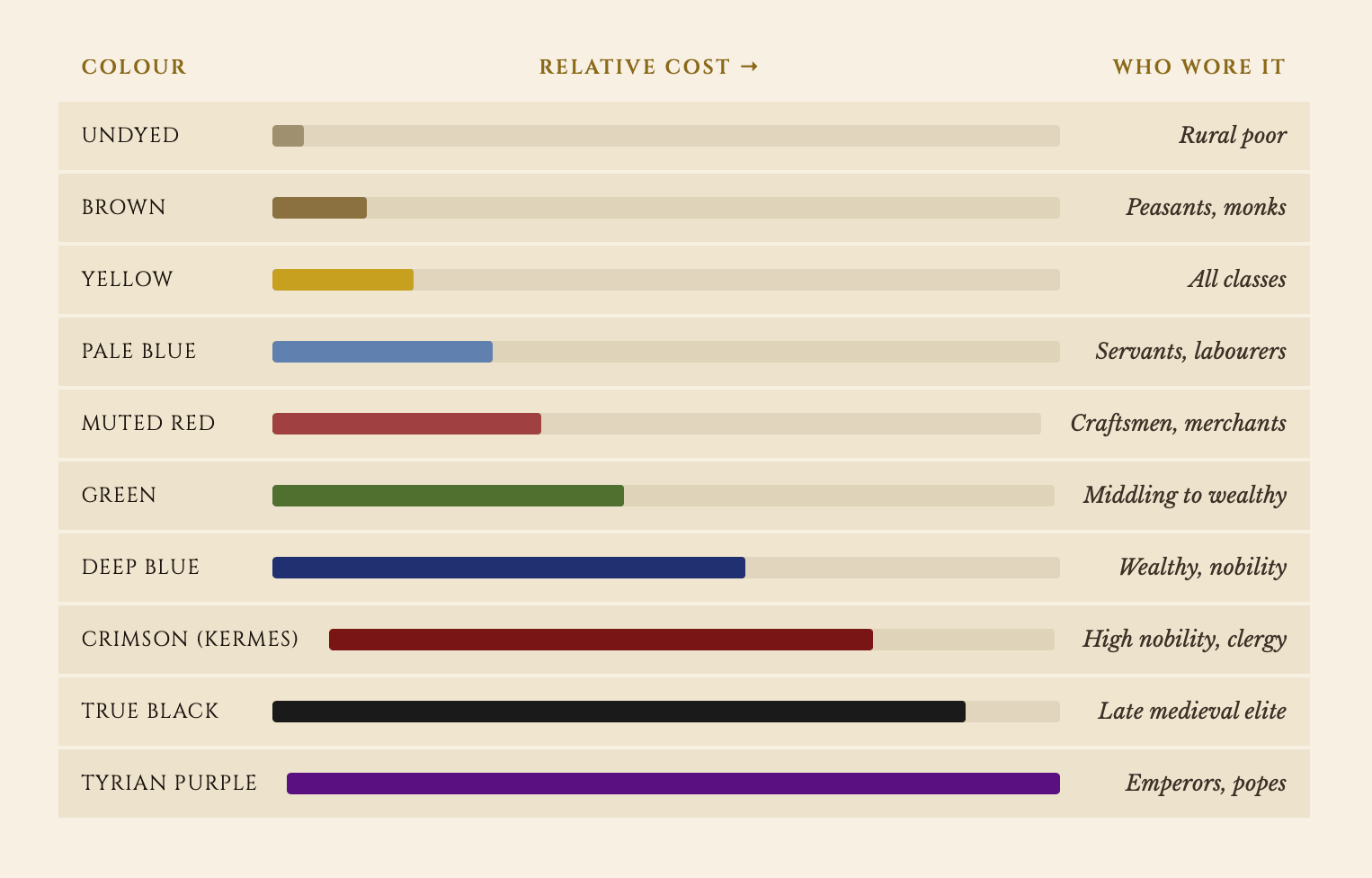
The Price of Colours
The richer the hue, the deeper the dyer's craft - and the heavier the purse required to pay for it.
What made a colour expensive was, above all, the difficulty of making it. Before the invention of synthetic dyes in the nineteenth century, every shade had to be coaxed from plants, insects, minerals, or sea creatures through laborious, smelly, and chemically precarious processes. Some dyes could be produced by any village woman with a handful of local weeds and a pot over a fire. Others required exotic imported ingredients, elaborate sequences of dye-baths, and the expert hands of a guild-trained master dyer. The gap between those two worlds was precisely the gap between peasant and prince.
Dye-baths
mordants
Medieval dyeing was far from simple colour-washing. To get a dye to bond properly with wool, linen, or silk, a mordant was required - a mineral compound, typically alum (potassium aluminium sulphate), iron, or copper, that fixed the colour into the fibres and prevented it from washing out too quickly. The choice of mordant dramatically altered the final shade: the same madder root could produce blood-red, dusty rose, or warm orange depending on what mordant preceded it in the bath.
dyestuff
Dye-baths were also stratified by use. The first batch of cloth into a freshly prepared bath absorbed the most concentrated colour - rich, deep, and saturated. Subsequent batches drew progressively weaker colour from the exhausted liquid, producing paler, muddier, or more faded versions of the same hue. These so-called "exhaust colours" were far cheaper to produce precisely because they required no fresh dyestuff. Saturated, vivid colours therefore cost more by nature - not only in raw materials, but in the sheer quantity of dyestuff consumed per yard of cloth.
Overdyeing
Overdyeing - passing fabric through two or more separate dye-baths in sequence - added yet another layer of cost. To achieve a true, bright green, for instance, one needed to dye the cloth first blue (an expensive and technically demanding process) and then yellow. The compound result was both more complex and more costly than either colour alone. Truly dark and intense shades - near-black, deep purple, or saturated forest green - typically demanded multiple overdyeing stages, multiplying both the cost of dyes and the hours of skilled labour required.
"The more saturated a colour you wanted, the harder it was to make. Saturated fabrics were more expensive than the more faded tones - undyed fabrics would be a sure way to mark you as poor and low status."
-
Postej & Stews, Medieval Textile Research
plant dyes
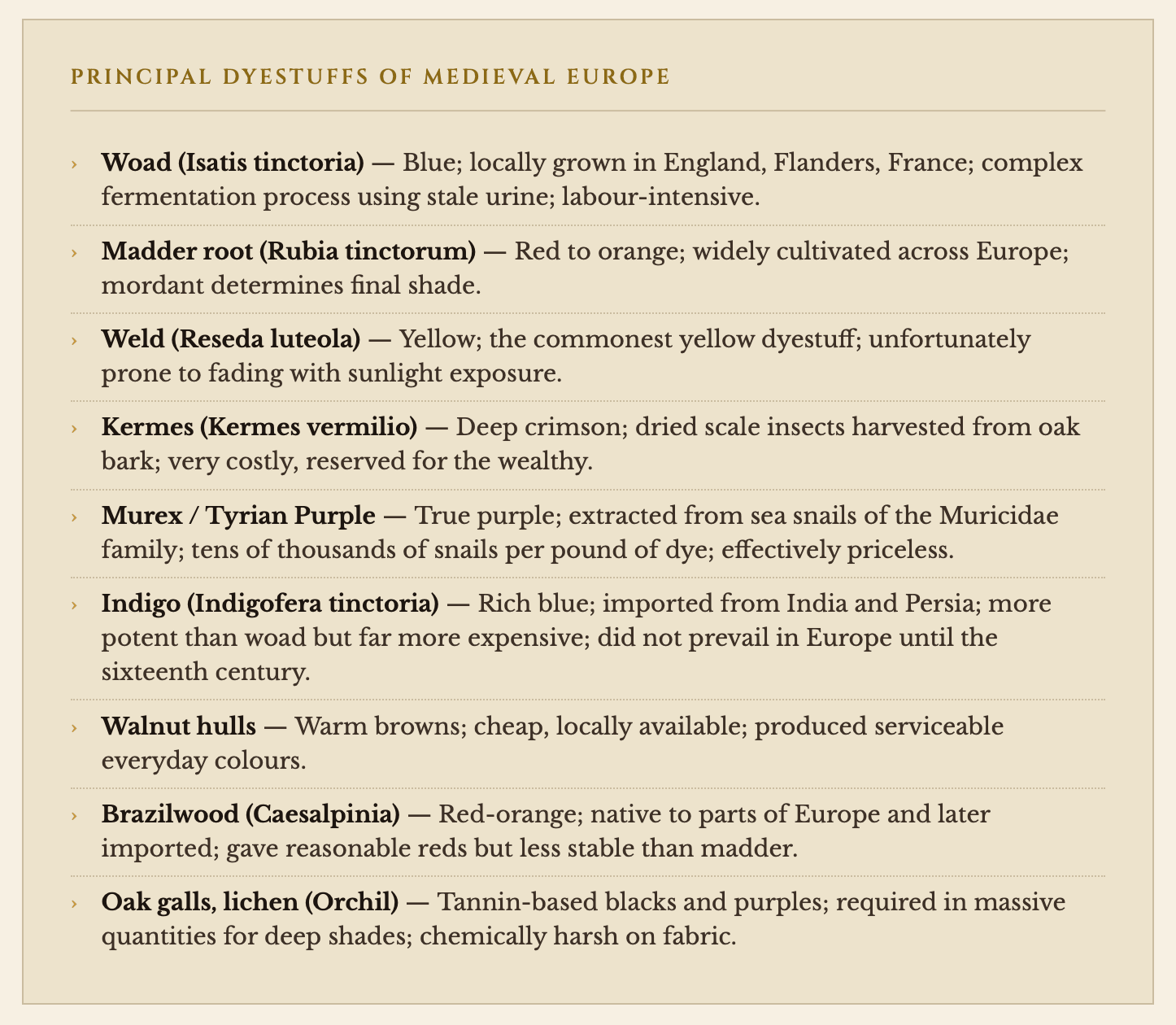
Many common dyes were plant-based and locally sourced. Woad, grown across England, Flanders, and northern France, was the principal source of blue. Extracting the dye was not simple - the harvested leaves had to be fermented in stale urine (for its ammonia content), shaped into balls, and left to cure for weeks. The dye itself was not water-soluble, requiring a complex reduction process in a vat before cloth could be immersed. It was difficult, malodorous work, and woad-farming was so bad for the soil that the French crown and Italian city-states eventually introduced laws restricting where it could be grown.
Madder root, originally native to the Middle East but cultivated in northern Europe by the ninth century, produced a range of warm reds, rusts, and oranges depending on the mordant used.
"The lust for blue drove many medieval farmers to ruin. They could grow woad easily and make a fast profit, but the plant stripped the land of its salts and left it barren and unusable."
-
Buckinghams Retinue, Medieval Dyeing and Ideas Abour Colour

Insects & Sea Creatures
At the very pinnacle of expense stood the animal-derived dyes.
Kermes - the dried bodies of a tiny scale insect harvested from Mediterranean oak trees - produced a brilliant, deeply saturated crimson that was extraordinarily difficult and expensive to gather.
Even more costly was genuine Tyrian purple, extracted from the hypobranchial gland of Murex sea snails. Producing a single pound of dye required tens of thousands of snails, each crushed or pricked to release a tiny drop of liquid. The resulting colour was so extravagantly expensive that it had been the colour of emperors and gods since antiquity, and its legacy clung to the symbolism of purple throughout the Middle Ages and beyond.
From Undyed Wool to Imperial Purple
The Colour Hierarchy
The relationship between colour and class in medieval Europe was so fundamental that across much of European cities and kingdoms sumptuary laws were enacted. These laws regulated who could wear which colours, which fabrics, and which combinations. They served multiple purposes: maintaining visible social distinctions between nobility and merchant class, preventing wealthy commoners from dressing above their station; and marking or shaming particular social groups. Violations were punishable by substantial fines.
At the very bottom of the colour hierarchy sat those who wore no dye at all. Raw, undyed wool - the colour of the sheep it came from - ranged from off-white and grey through to pale brown. It cost nothing to colour (because it was not coloured) and signalled poverty and low status immediately to any observer. Some monastic orders wore undyed habits by choice, as an act of deliberate humility, but for the rural poor it was simply a matter of economics.

a closer look at
Color codes
Yellow: Ambiguity & Stigma
Yellow occupies one of the most complicated positions in the medieval colour hierarchy. It was one of the easier and cheaper colours to produce - and as such it was worn by people of many classes. But it also carried a troubling social charge. Yellow became associated with marginality and moral deviance in ways that cut across its accessibility as a dye.
Sumptuary laws across several medieval cities required prostitutes and, in many cases, Jewish residents to wear yellow or saffron-coloured garments or markers as a form of public identification. The evidence is not uniform across Europe and different cities required different colours for different stigmatised groups. Historians also caution against overstating the stigma: many people of perfectly respectable standing wore yellow without any stigma at all, and the picture varies enormously by time and place.
Green: Youthful, Earthy, & Complicated
Green was a colour deeply embedded in the medieval imagination - associated with youthfulness, spring, fertility, and vitality. Chaucer's Yeoman wears green; the colour of the forest and natural abundance. But true green was not a simple colour to produce and it was always more expensive than either of its components produced alone. Very bright or saturated greens were depicted on wealthy figures in manuscript illuminations, while muddier, darker greens were the more accessible end of the spectrum.
Green also carried some unsettling symbolic weight. Despite its associations with life and growth, it was simultaneously regarded in many quarters as an unlucky colour - linked to the supernatural, to fairies and the uncanny, and to the physical decay that follows death. "Giving a girl a green gown" was a winking medieval euphemism for rolling in the grass together.
Red: Power & Charity
Red was, in many respects, the defining colour of medieval nobility and power. It was available in a wide range of intensities and qualities depending on the dyestuff used. Madder root produced warm, accessible reds that a prosperous merchant or craftsman might wear. Brazilwood produced similar, if less stable, hues. But brilliant kermes red - known in English as "grain" dye - was a colour sp expensive that it was the near-exclusive preserve of the highest nobility and clergy. Kermes crimson was what the cardinals wore, what the great lords displayed at court, and what the portraits of Renaissance princes were painted in.
Red was also, paradoxically, the colour most associated with charity in medieval moral symbolism - an interesting tension given its simultaneous role as the colour of earthly power and aristocratic display.
Blue: From Livery to the Virgin Mary
Blue presents a fascinating paradox in the medieval colour story. At one end of the spectrum, pale woad-blue became the colour of servants and liveries in parts of England and northern Europe - called "tawny blue". At the other extreme, the Virgin Mary was conventionally painted in an extraordinary, luminous blue - achieved in painting with the ruinously expensive pigment lapis lazuli - and richly saturated blue became a colour of profound spiritual and aristocratic prestige.
The key, as with green, was the quality and intensity of the shade. The murky, pale blue of a servant's woad-dyed livery was worlds apart from the deep, saturated blue of cloth dyed with costly imported indigo from India and Persia.
White: Purity & the Problem of Dirt
In the medieval world, white and cream were almost universally the colours of underwear - the garment that had to be washed most frequently, since the outer layers rarely if ever met water.
As outer dress, white was a symbol of extraordinary wealth - because keeping a white outer garment clean in the dust, mud, and soot of a medieval city was an expensive, time-consuming, and practically near-impossible challenge. It was a colour that demonstrated, at a glance, that its wearer did not engage in manual labour.
White also held strong liturgical associations: purity, virginity, and spiritual cleanliness.
Black: The Most difficult one
Dense black was perhaps the most technically demanding colour a medieval dyer could attempt. To achieve a black that would not fade into dark brown or greenish grey, a dyer had to use enormous quantities of tannin-based dyestuffs - oak galls, combinations of blue and red in successive overdye baths - along with chemical mordants, particularly alum, in such concentrations that they actually degraded the fabric fibres over time. A garment dyed a true, sumptuous black would rot faster than one dyed in a simpler colour.
Ironically, black was simultaneously the colour of monastic humility - worn by Benedictine monks and associated with poverty and withdrawal from worldly vanity - and the colour of the most extravagant courtly fashion of the Middle Ages.
The Issue with Sumptuary Laws
Fashion as Legal Territory
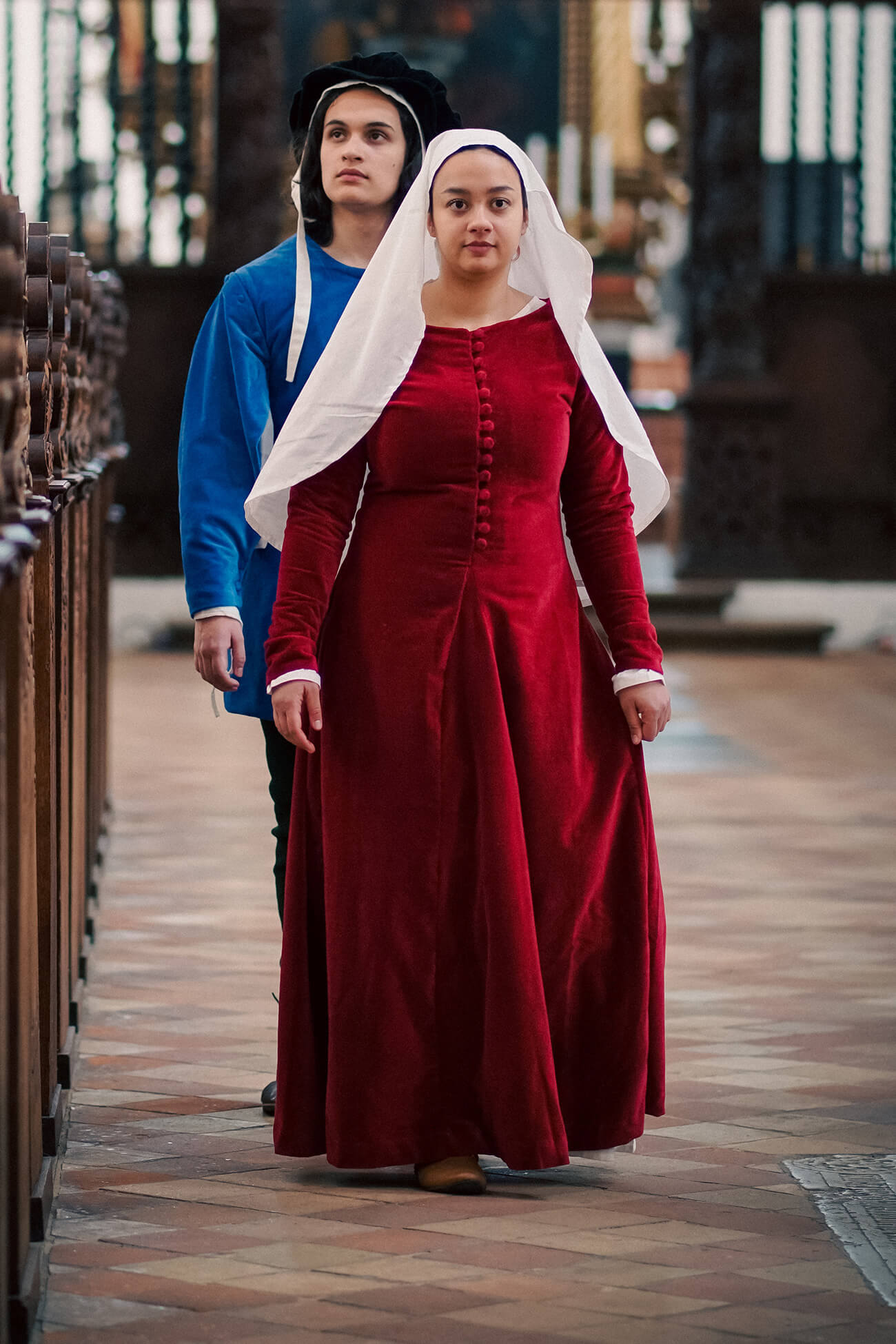
Because the social language of colour was so legible, it was also constantly under pressure from those who could afford to buy above their station. A prosperous merchant who had made a fortune in cloth - but was not of noble blood - might very well be tempted to dress in crimson. And that, to the medieval mind, was a threat to the fundamental visibility of the social order.
The sumptuary laws were extraordinarily specific. In Venice, only the Doge and his family could wear certain scarlet robes. Elsewhere, sumptuary laws specified not only which colours but which combination of colours and which quality of dye were permitted to which rank of person. The guilds of dyers were deeply implicated in this system, giving them considerable social power.
Violations carried real penalties: fines, confiscation of the offending garment, and public shame. And yet the laws were constantly evaded, and constantly updated. The very existence of sumptuary legislation, repeated in wave after wave across European cities, is itself evidence that people were perpetually attempting to dress above their legal station - and that colour remained, for centuries, the primary legible grammar of social rank.
Read more
5 Easy Ways to Customise Your Yoremade Gear
Whether you're gearing up for your first event or looking to breathe new life into a well-loved set, these five techniques will help you build a look that feels genuinely unique. Best of all, none ...
Read more
How to build a Renaissance Faire costume that lasts: a quality gear guide
Most first Renaissance Faire costumes come from Amazon, get worn once, and end up forgotten in a box. Not because the enthusiasm faded - but because a cheap costume simply isn't built for a full da...
Read more